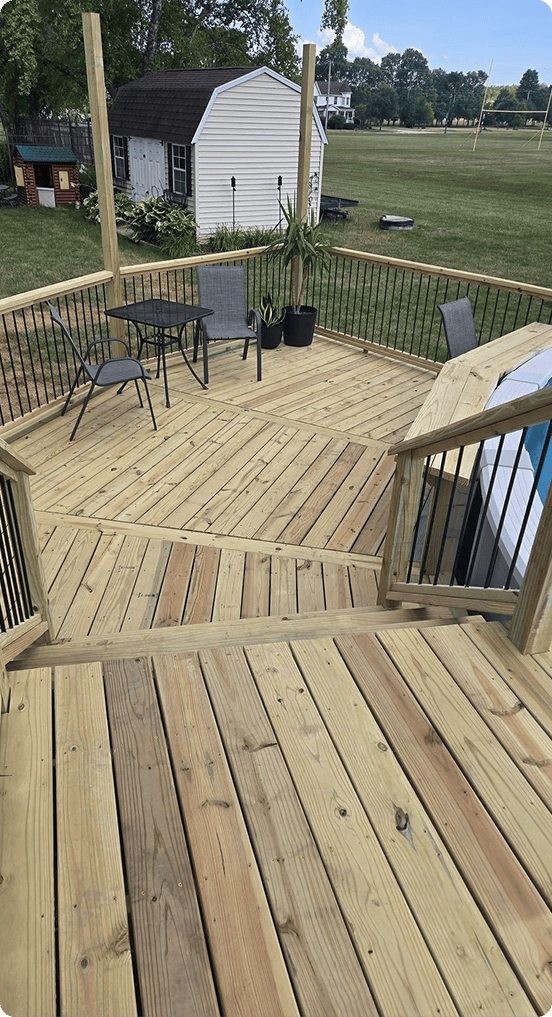
Deck building Fort Mill SC projects require careful planning around permits, materials, and code requirements. A well-built deck adds living space, boosts home value, and gives you a place to enjoy those long Carolina evenings. But building a deck is also one of the most code-regulated projects on your property. Skip the permit, use the wrong fasteners, or frame the ledger wrong, and you are looking at a structure that can fail under load. Nick has been building custom decks across York County for over 25 years, and he has seen what happens when corners get cut.
This guide walks through the permit process, material choices, and code requirements for building a deck in Fort Mill. Whether you are planning a small ground-level platform or a large multi-level deck with stairs and railing, the same rules apply. If you want professional help, our custom deck building services cover the full process from permit to finish.
Do You Need a Permit to Build a Deck in Fort Mill?
Yes. The Town of Fort Mill requires a residential building permit for any deck attached to a house or any deck more than 30 inches above grade. The building department reviews plans using the 2021 International Residential Code. You must submit a completed application, a plot plan showing setbacks, and construction documents before work begins.
The Town of Fort Mill Building Department has a specific deck construction review checklist that outlines exactly what you need to submit. The plans cannot be processed without all items on the checklist. That includes a plot plan showing actual setbacks from property lines, footing details, framing plans, and guardrail specifications. If you are a homeowner acting as your own general contractor, you must file an Owner/Builder Disclosure with the York County Register of Deeds and live in the house for two years. The permit fee varies based on the project value. Inspections are required at the footing stage, framing stage, and final.
What Materials Are Best for Deck Building in Fort Mill?
The best deck materials for Fort Mill homes are pressure-treated southern yellow pine for framing and either pressure-treated wood, composite, or PVC for the decking surface. Pressure-treated lumber is the most affordable and widely used. Composite and PVC cost more but require less maintenance and last longer in our humid climate.
We build most of our decks in Fort Mill with pressure-treated southern yellow pine for the structural frame. It is strong, readily available at local lumber yards, and holds up well in our climate when properly sealed. For the decking surface, we offer three main options. Pressure-treated wood is the budget choice. It needs sealing every 2 to 3 years. Composite decking like Trex or TimberTech costs more up front but never needs staining. PVC decking is the premium option, fully synthetic and resistant to moisture, mold, and fading. Here is how we break it down for homeowners:
- Pressure-treated wood: affordable, needs regular sealing.
- Composite: low maintenance, mid-range price.
- PVC: premium, fully synthetic, longest lifespan.
In our experience, homeowners who plan to stay in their home for 10-plus years usually go with composite. It pays for itself in maintenance savings. If you are on a tighter budget or planning to sell in a few years, pressure-treated wood makes more sense.
What Are the IRC Code Requirements for Decks?
The International Residential Code requires guardrails on any deck surface more than 30 inches above grade. Guardrails must be at least 36 inches tall for residential decks. Baluster spacing cannot allow a 4-inch sphere to pass through. Deck stairs need handrails on one side if they have four or more risers. Footings must extend below frost depth.
These are not suggestions. They are code requirements that the Fort Mill building inspector will check during your framing and final inspections. According to the North American Deck and Railing Association (NADRA), there are more than 60 million decks in the United States, and an estimated 30 million of them have exceeded their useful life. Many of those older decks were built before the IRC started requiring proper ledger connections in 2009. If you have an existing deck that was built before 2009, it is worth having it inspected. The framing may not meet current code, even if it still looks solid from the surface.
How Do You Properly Attach a Deck Ledger Board?
A ledger board must be attached to the house with lag screws or through-bolts, not nails. The IRC requires half-inch lag screws or bolts spaced according to the joist span. Flashing must be installed behind the ledger to prevent water from getting between the deck and the house. Nailed-only ledger connections are the leading cause of deck collapses.
This is the most critical connection on any attached deck. NADRA reports that approximately 90 percent of all deck collapses result from ledger board connection failures, and most of those involve nailed-only connections. When we build a deck, we use half-inch through-bolts with washers on both sides. We install metal flashing behind the ledger, lapped over the top edge so water runs out and away from the house. We never nail a ledger. Nails can pull out under lateral load, especially after years of thermal cycling in the Carolina heat. If your existing deck has a nailed ledger, it needs to be retrofitted with bolts before you put weight on it again.
What Size Footings Do Decks Need in Fort Mill?
Deck footings in Fort Mill typically need to be 12 inches in diameter minimum and extend at least 12 inches below grade, or below the local frost line. York County falls in a marginal frost zone, so 12 to 18 inches is common. The footing must bear on undisturbed soil and support the calculated load for the deck size and occupancy.
We pour concrete footings with Sonotube forms. The diameter depends on the deck size and the soil bearing capacity. For a standard residential deck, 12-inch footings on 8-foot centers work for most spans. For larger decks or decks with hot tubs, we step up to 16-inch footings and reduce the spacing. The building inspector will check the footing depth and diameter before you pour concrete, so do not skip that inspection. We have seen decks in Rock Hill where the footings were poured too shallow, and after one winter the posts started heaving. The deck became uneven, and the railing loosened. Fixing footings after the deck is built is expensive and frustrating.
What Are the Top 5 Deck Building Mistakes to Avoid?
The five most common deck building mistakes are using nails instead of bolts on the ledger, skipping the permit, undersizing footings, spacing balusters too wide, and failing to flash the ledger board. Each of these mistakes can cause inspection failures, premature rot, or structural failure. Here is the list we share with every client before we start a project.
- Nailing the ledger board instead of bolting it.
- Skipping the building permit and inspections.
- Pouring footings too shallow for the soil.
- Spacing balusters wider than 4 inches apart.
- Skip flashing behind the ledger board entirely.
Every one of these mistakes is preventable. The permit process exists to catch them before the deck becomes a safety hazard. We have been building decks in Fort Mill for over 25 years, and we have never failed a framing or final inspection. That is because we follow the code on every connection, every spacing requirement, and every footing depth.
What Makes Deck Building Fort Mill SC Projects Different?
Deck building Fort Mill SC projects are governed by the Town of Fort Mill building department, which uses the 2021 International Residential Code. The local climate, soil conditions, and permit requirements all affect how a deck should be designed and built. Working with a contractor who knows the local process saves time and avoids inspection failures.
How Long Does It Take to Build a Deck in Fort Mill?
A standard residential deck in Fort Mill takes 5 to 10 days of construction time once the permit is approved. The permit review process typically takes 2 to 3 weeks. Weather delays are common in spring and summer due to afternoon thunderstorms. Total timeline from permit application to final inspection usually runs 4 to 6 weeks.
We build decks in phases. First, we pull the permit and submit the plans. Once approved, we set footings and let the concrete cure for 48 hours. Then we frame the deck, install the ledger, joists, and beams. The framing inspection happens next. After it passes, we install the decking surface, railing, and stairs. The final inspection closes out the permit. If you also need staining or painting, we handle that separately. Our deck and fence painting service can stain or seal your new deck after installation.
How Much Does a Deck Cost in Fort Mill, SC?
A pressure-treated wood deck in Fort Mill typically costs $25 to $40 per square foot installed. Composite decks run $40 to $65 per square foot. PVC decks can reach $60 to $85 per square foot. A 200-square-foot pressure-treated deck usually totals $5,000 to $8,000. Material choice, deck height, railing style, and stair complexity all affect the final price.
We are not the cheapest deck builder in York County. We know that. What we can promise is that your deck will pass every inspection, hold up to Carolina weather, and still look good in 10 years. We use the right fasteners, the right flashing, and the right framing for the load. If you are comparing estimates, ask each contractor whether they bolt the ledger, what size footings they pour, and whether they pull permits. The answers tell you everything you need to know about the quality of the build.
Frequently Asked Questions About Deck Building in Fort Mill
Can I build a deck without a permit in Fort Mill?
No. The Town of Fort Mill requires a building permit for any deck attached to a house or any deck more than 30 inches above grade. Building without a permit can result in stop-work orders, fines, and difficulty selling your home later. The permit process also ensures your deck meets safety standards that protect your family and guests.
How far apart should deck joists be spaced?
Deck joists are typically spaced 16 inches on center for standard residential loads. If you are using composite decking or planning for heavy loads like a hot tub, joist spacing may need to be reduced to 12 inches on center. The joist size and span also depend on the decking material and the live load rating required by the IRC.
What is the maximum baluster spacing on a deck?
The IRC requires that no opening in a deck guardrail allows a 4-inch sphere to pass through. This means the space between balusters, between balusters and posts, and between the bottom rail and the deck surface must all be less than 4 inches. This rule exists to prevent small children from slipping through the railing.
How deep do deck footings need to be in South Carolina?
Deck footings in South Carolina typically need to extend at least 12 inches below grade to reach undisturbed soil and stay below the frost line. York County is in a marginal frost zone, so 12 to 18 inches is standard. Your local building inspector can confirm the exact depth required for your specific location and soil type.
Can I use a deck permit from York County instead of Fort Mill?
If you live inside the Town of Fort Mill limits, you need a permit from the Fort Mill Building Department, not York County. If you live in unincorporated York County, you would apply through York County. Check your address on the town boundary map to confirm which jurisdiction handles your permit before you submit plans.
How often should I seal a pressure-treated deck?
A pressure-treated wood deck should be sealed or stained every 2 to 3 years in the Fort Mill climate. Our summers bring high humidity and UV exposure that break down wood sealants faster than in drier climates. Composite and PVC decking do not require sealing, which is one reason many homeowners choose those materials despite the higher upfront cost.
Does a deck add value to a home in Fort Mill?
Yes, a well-built deck adds value to a Fort Mill home. A quality deck can return 60 to 75 percent of its cost in added home value, according to remodeling industry estimates. Decks are one of the few home improvements that add usable living space at a lower cost per square foot than a room addition.
Ready to Build Your Fort Mill Deck?
Building a deck in Fort Mill is a project that rewards doing it right the first time. The permit process catches mistakes before they become dangerous. The right materials hold up to Carolina weather for years. And proper construction techniques, from bolted ledgers to correctly spaced balusters, keep your family safe every time you walk outside.
Nick and the team at Blue Rock Roofing and Construction have been building custom decks across Fort Mill, Rock Hill, Charlotte, and Gastonia for over 25 years. We are a family-owned business that handles the permit, the framing, the inspections, and the finish work. Call us at (704) 266-0448 or visit our contact page to schedule a consultation. We will walk your property, talk through your options, and give you an honest estimate for a deck built to last.
Frequently Asked Questions
What happens if I build a deck in Fort Mill without pulling a permit?
Building without a required permit can lead to a stop-work order, fines from the Town of Fort Mill, and major complications when you sell your home. Unpermitted decks often fail home inspections and buyers can demand the structure be brought up to code or removed. Our team always pulls permits first so your deck is documented, inspected, and legally sound from day one. Call us at (704) 266-0448 before you break ground.
Can I build my own deck if I am not a licensed contractor?
Yes, but South Carolina and the Town of Fort Mill require homeowners acting as their own general contractor to file an Owner/Builder Disclosure with the York County Register of Deeds and live in the home for two years afterward. Many homeowners find it simpler to hire a licensed builder. Our custom deck building team handles the entire permit and construction process for you.
How much weight can a properly built deck in Fort Mill hold?
A residential deck built to the 2021 International Residential Code must support a live load of 40 pounds per square foot, plus dead load from the structure itself. According to the North American Deck and Railing Association, undersized framing is a leading cause of deck failure nationwide. We calculate load requirements before pouring footings so your deck safely handles exactly what you plan to put on it.
Will a wood deck warp or twist in Fort Mill’s humidity?
Pressure-treated southern yellow pine can warp or twist if it is not properly dried, spaced, and fastened during installation. Our crews use kiln-dried lumber where possible and follow correct fastening spacing to minimize movement as the wood acclimates to Carolina humidity swings. Composite and PVC decking, discussed on our deck building page, avoid this issue entirely since they do not absorb moisture.
Can I add a roof or pergola over my new deck later?
Yes, many Fort Mill homeowners add shade structures after living with a bare deck for a season. Adding a roof or pergola after the fact requires additional footings and structural support beyond what a basic deck frame provides, so we recommend telling your builder upfront if this is a future goal. Our covered porch and pergola installation team can design for this from the start or retrofit an existing deck.
How do I maintain a new deck during its first year in Fort Mill?
Inspect fasteners and railing connections after the first few months as lumber settles, and reseal pressure-treated wood once it has fully dried out, typically 60 to 90 days after installation. Sweep debris out of gaps between boards to prevent moisture retention, especially heading into our humid summer months. Composite and PVC decks need little more than periodic washing during this period.